
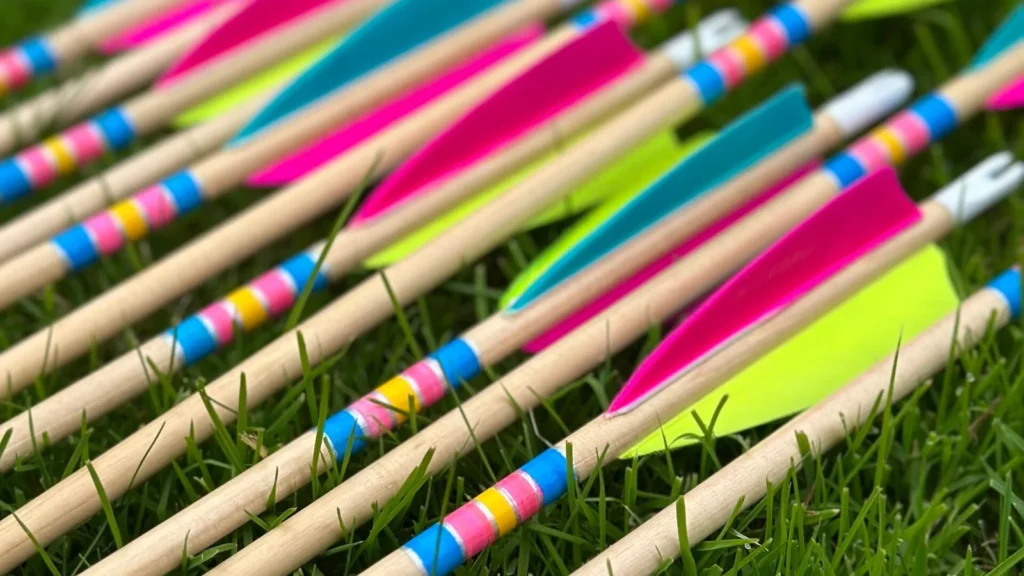
“What’s the best wood for arrow shafts?”
Like most things in archery, there isn’t a simple answer.
Ash, cedar, spruce, pine… every timber has its supporters, and every archer has their favourite. At Wildwood Rangers, we always encourage people to understand why a particular material has been chosen rather than simply following the latest trend.
One timber that deserves far more attention than it often gets is Scots Pine, sometimes sold as Scandinavian Redwood.
Why Scots Pine?
The arrow shafts we use are made from structural-grade Scots Pine (Scandinavian Redwood) sourced from FSC and PEFC certified suppliers.
That choice wasn’t made by accident.
Chris, who developed these shafts, spent several years testing different timbers before settling on Scots Pine. After more than thirty years of making and shooting arrows from this material, it’s built a reputation for being consistent, durable and reliable.
Rather than reinventing the wheel, we’ve continued using the same timber because, quite simply, it works.
Not All Pine Is the Same
One of the biggest misconceptions we come across is that all pine arrow shafts are identical.
They aren’t.
You’ll often see terms such as:
- Northern Pine
- Norwegian Pine
- Scots Pine
- Scandinavian Redwood
used almost interchangeably, but they are not always describing the same material.
That’s worth understanding before buying your next set of arrows.
Scandinavian Redwood vs Northern Pine
Although retailers sometimes group these timbers together, they’re generally quite different in both appearance and performance.
Scandinavian Redwood is slow grown in the colder climates of Sweden and Finland. Because the trees grow more slowly, the timber develops much tighter annual growth rings.
Why does that matter?
Tighter growth rings generally produce a denser, stronger shaft with excellent consistency.
Northern Pine, particularly the varieties grown in North America, tends to grow more quickly. Faster growth usually means wider grain spacing and a lighter shaft.
Neither is necessarily “better”—they simply behave differently.
For traditional arrows, that difference can become noticeable.
What About Spruce?
Spruce has always been popular with target archers because it’s incredibly light.
A lighter arrow can be an advantage in some situations, but there’s always a balance to strike.
Scots Pine tends to offer a little more durability without adding excessive weight, making it an excellent all-round choice for field archery and traditional shooting.
As always, the most important factor is having arrows matched correctly to both your bow and your shooting style.
An arrow that’s perfectly matched will nearly always outperform one made from a supposedly “better” timber that’s completely wrong for the bow.
Why Slow-Grown Timber Matters
The further north a tree grows, the shorter its growing season.
That slower growth produces tighter grain, giving the timber several advantages:
- Greater density
- Better stability
- Less movement over time
- Improved durability
- More consistent spine characteristics
These are all qualities that matter when producing traditional wooden arrows.
The Joiner’s Choice
In the woodworking world, Scandinavian Redwood has long been known as the Joiner’s Choice.
It’s widely used for quality furniture, cabinetry and fine joinery because it machines cleanly, remains stable and finishes beautifully.
Those same qualities make it well suited to arrow making.
A straight, stable shaft is exactly what every traditional archer is looking for.
Scandinavian Redwood or Norwegian Pine?
This is another area that often causes confusion.
Both Scandinavian Redwood and Norwegian Pine come from the same species—Scots Pine (Pinus sylvestris).
The differences are usually down to where the tree has grown, rather than the species itself.
Trees growing in colder regions generally grow more slowly, resulting in tighter growth rings and denser timber.
In practice, high-quality Scandinavian Redwood and Norwegian-grown Scots Pine perform very similarly.
What matters far more is the quality of the timber and how carefully the shafts have been selected and matched.
It’s About More Than the Wood
One thing we’ve learnt over the years is that people often spend too much time worrying about whether they should buy pine, spruce or cedar.
The timber certainly matters.
But it’s only one piece of the puzzle.
A well-made shaft that’s correctly matched to your bow, draw length and shooting style will almost always outperform an expensive shaft that’s poorly matched.
That’s why we believe matching arrows properly is far more important than chasing fashionable materials.
Our Philosophy
At Wildwood Rangers, we like equipment that works.
We’re far more interested in reliability, consistency and real-world performance than marketing buzzwords.
Scots Pine has earned its place through decades of practical use.
It’s strong.
It’s stable.
It’s predictable.
Most importantly, when matched correctly to the archer, it produces arrows that simply do what they’re supposed to do—fly true.
And in traditional archery, that’s what really matters.